
When the appointment turns violent: the rising toll of abuse against doctors and dentists
Author: MDDUS | Date: 21 April 2026

At a glance:
- Escalating abuse: Over 80% of GPs and 95% of dental staff report verbal violence; one in seven NHS workers face physical assaults.
- Compounded crises: Post-pandemic strain and the cost of living crisis have intensified patient frustration and workplace aggression.
- Policy response: Despite zero-tolerance campaigns and new standards, protections have yet to deliver safer surgeries and clinics.
"If you don't give me that prescription, I'm going to kill you".
This is a real threat made against a doctor working as a nurse consultant in East Yorkshire in 2024. Another demand for a repeat prescription ended with a doctor being knocked unconscious with a metal pole in Manchester.
As MDDUS surveys have shown throughout the years, doctors are no strangers to verbal and physical abuse by patients. Over 80% of GPs reported experiencing it in 2024.
National data quoted by a Liverpool John Moores University report on work-based violence, harassment and abuse towards NHS staff in England (December 2024) suggests that there are as many as 200 assaults on staff per day. In A&E departments, the average is 80 incidents of violence, harassment and abuse per 100,000 attendances.
The numbers are also high for dentists. A study published in July 2025 by Frontiers in Public Health found that 95% of dental staff had experienced verbal violence, while the figure for physical violence was 27%.
Measures introduced to improve working conditions, such as the NHS’s zero-tolerance campaign, initially launched in 1999, have brought little relief.
When the stakes are so high and the resources so low as is the case with medical care, what impact does this have on the performance and the well-being of these professionals?
The compounded effect of two crises
The Health and Safety Executive (HSE) defines violence at work as “any incident in which an employee is abused, threatened or assaulted in circumstances relating to their work”.
In the context of the NHS, documented cases include physical assault and aggression, verbal aggression, abuse or threats —including those of sexual nature—, harassment and bullying.
The latest NHS survey from 2024 revealed that one in seven, or 14.38% of staff (medical, dental, ambulance, nurses and midwives; administrative, clerical and technical personnel), had been subjected to physical violence from patients, their relatives or other members of the public the previous year. One in four faced harassment, bullying or abuse (25.8%).
This was a significant decline compared to the previous years, where the combination of the post-pandemic and the cost of living crisis fuelled the animosity towards medical professionals.
58% of respondents to our 2023 members survey said that things were worse than during the Covid-19 years. According to that research, the percentage of GPs reporting receiving verbal abuse was an alarming 85%.
In one in six cases the police had to be called in.
“We know all too well that the Covid-19 pandemic had a catastrophic impact on primary care. However, what many people don’t realise is the extent to which the cost of living crisis has compounded matters for both GPs and patients”, said Dr John Holden, chief medical officer at MDDUS and former GP.
Our research identified ‘lack of access to face-to-face consultations’ and ‘complaints about their quality of care’ as the factors that most often escalated to verbal abuse.
“All too often GPs find themselves on the sharp end of patients’ frustrations about a health service that doesn’t appear to live up to their expectations”, said Dr Holden.
“Nobody should go to work fearing verbal abuse and physical violence”.
Training spotlight: Dealing with persistent or unreasonable complaints
From burnout to suicidal ideation
NHS leaders have echoed this sentiment.
The “increase in violence to members of primary care teams is extraordinary”, said Claire Fuller, NHS England’s primary care medical director, earlier this year.
“When you talk to GPs about why they leave (the profession), they say one is about the workload, and the other is about respect,” Fuller added.
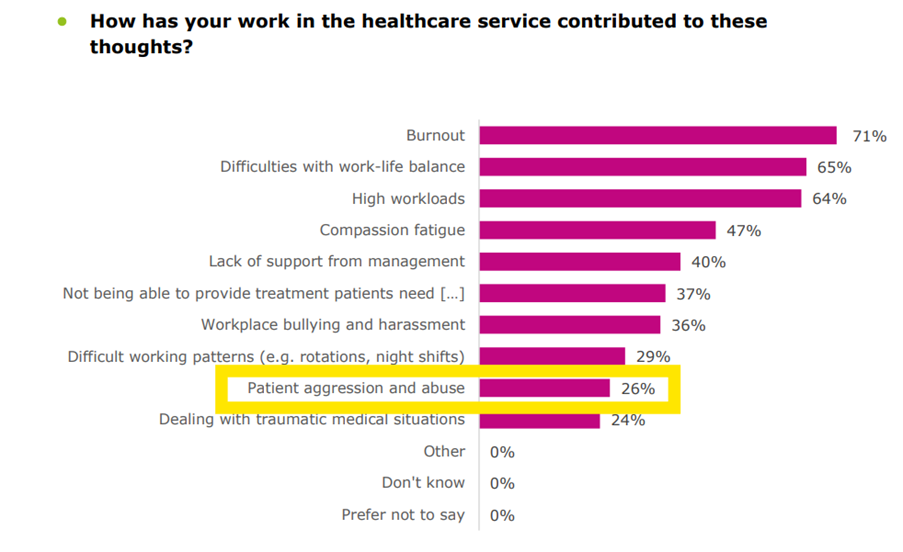
Our most recent survey, run in October 2024, explored the link between abuse and burnout, with 24% of doctors citing it as a reason for fatigue and exhaustion.
More worryingly, the same report showed that 21% of GPs had had “thoughts of self-harm or suicide”, and that patient aggression and abuse was one of the reasons behind them in 26% of cases.
The Liverpool John Moores University report also looks into the organisational impact of abuse and harassment against NHS personnel. Staff sickness and absences put pressure on staffing; low productivity and potential litigation translate into real financial costs.
And then there are the consequences for the quality of patient care.
“Violence, harassment and abuse in the workplace can hinder staff from delivering high-quality care to patients, as it can lead to demotivation, decreased engagement, and presenteeism among healthcare workers.
“Working relationships with colleagues may be affected. Staff may disengage from their work as a protective measure, further raising the likelihood of unmet patient needs and adding further burden to their colleagues”, it says.
What is being done
The research also alerts to the acceptance of violence as given: “Cultures within the healthcare sector often encourage staff to ‘just get on with it’ (…). This normalisation hampers incident reporting”.
Reporting is a key issue included in a support package announced by the UK government earlier this year to address violence and improve the lives of NHS staff.
“Protecting staff from violence is not an optional extra”, said Health Secretary Wes Streeting.
Streeting declared it “mandatory” and pledged “zero tolerance for violence and harassment for NHS staff”.
His words followed the release, a few months earlier, of an updated Violence Prevention and Reduction (VPR) Standard, which requires trusts to self-assess across leadership, governance, workforce, data, interventions, collaboration, and evaluation.
The standard emphasises the need to “understand what is causing and influencing violence” to tackle the problem at its root, while reminding NHS employers that they have a legal responsibility to protect staff from threats and violence at work and to “ensure that all staff feel safe, supported and empowered to report incidents (…) and feel confident that action will be taken”.
These are signs that the issue is being taken more seriously. But until those protections translate into safer surgeries and clinics, the risk remains high.
For the doctors and dentists who face it daily, the question is not only how long they can carry that burden, but how long the healthcare system can sustain the cost to its people, and to patient care.
Read more: Access, abuse and the hidden cost of throughput
MDDUS members struggling with their mental health can access a free and confidential wellbeing support service.
This page was correct at the time of publication. Any guidance is intended as general guidance for members only. If you are a member and need specific advice relating to your own circumstances, please contact one of our advisers.

Elsewhere in MDDUS
FAQs
-
Who is MDDUS?
MDDUS is the Medical and Dental Defence Union of Scotland. It is a mutual organisation that supports doctors, dentists and healthcare professionals by providing professional indemnity, expert advice and representation, and by advocating on issues affecting medical and dental practice.
-
What is News.MDDUS.com for?
News.MDDUS.com provides news, insight and expert commentary on issues affecting doctors, dentists and healthcare professionals. It explains key topics such as wellbeing, regulation and workforce pressures, helping journalists, policymakers and stakeholders understand the challenges facing healthcare today.
-
Where can I find MDDUS membership information?
MDDUS membership information is available on the main MDDUS website. Visit www.mddus.com to find details about joining, member benefits, professional support services and official guidance for doctors, dentists and healthcare professionals.
-
How do I contact MDDUS with media enquiries?
Media enquiries should be directed to the MDDUS press team. Journalists can contact the MDDUS press team by telephone on 07976 886 552 or by email at press@mddus.com to request information, comment or expert insight.